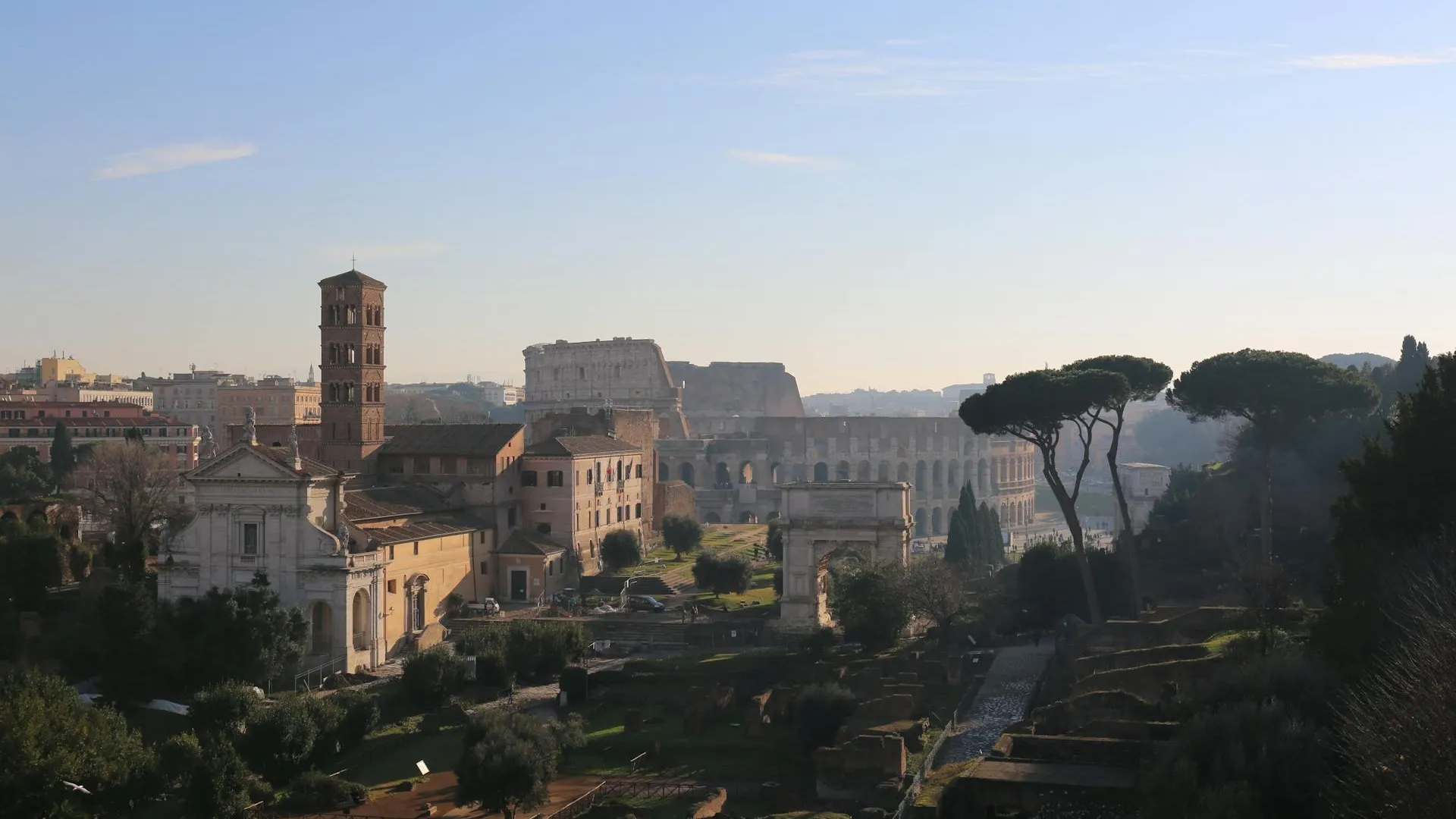
Rione Monti: Rome's Oldest Neighbourhood
Last updated:
Cobblestoned streets, local bars, and artisan shops between the Colosseum and Termini station.
Authentic Rome, Not Tourist Rome
Hotel Colle Oppio sits at Via Panisperna 82, in the heart of Rione Monti — Rome’s oldest rione. This is real Rome, where locals shop at alimentari, drink espresso standing at bar counters, and gather around the 16th-century fountain in Piazza della Madonna dei Monti each evening. You are steps from the Colosseum, surrounded by independent wine bars, artisan workshops, and trattorias, and connected to the city via Cavour metro three minutes away.
Monti functions as a self-contained village inside one of the world’s most visited cities. Via del Boschetto has owner-operated boutiques selling handmade leather goods and ceramics. Via dei Serpenti is lined with wine shops and trattorias open from morning to late evening. Via Panisperna holds artisan workshops at its lower end, and Mercato Monti’s weekend vintage market at Via Leonina 46 draws curated designers year-round.
Metro and Transport
Hotel Colle Oppio benefits from three nearby metro stations covering two lines, plus major bus routes on Via Nazionale.
Cavour (Line B) — 3-minute walk
Direct to Colosseo, Termini, and EUR. Walk north-west along Via Panisperna 250 metres to reach the entrance. Line B connects south to Colosseo (one stop) and north to Termini (two stops), with service from approximately 05:30 to 23:30 and extended hours to 01:30 on weekends.
Colosseo (Line B) — 8-minute walk
The station sits on Piazza del Colosseo at street level, with direct access to the Colosseum, Roman Forum, and Palatine Hill. For these sites it is usually faster to walk directly from the hotel than to take the metro.
Termini (Lines A + B + national rail) — 10-minute walk
The major hub for metro, national rail, and the Leonardo Express to Fiumicino Airport. Head along Via Cavour or Via Panisperna toward Piazza dei Cinquecento. Line A connects to Ottaviano-San Pietro for the Vatican. Long-distance buses depart from Tiburtina, two stops away on Line B.
Bus Lines on Via Nazionale
Via Nazionale is a 6-minute walk west and carries Bus 40 Express and Bus 64 to the Vatican, Bus 70 to Largo Argentina, and Bus H to Aventino. Night buses replace metro services after closing.
What’s Nearby
All walking times measured on foot from Via Panisperna 82.
Parco del Colle Oppio — 5 minutes
Green hilltop park with views to the Colosseum and Palatine Hill, sitting directly above the underground chambers of Nero’s Domus Aurea.
Piazza della Madonna dei Monti — 3 minutes
The neighbourhood’s central square, built around a 16th-century Della Porta fountain. Evening gathering point for locals and visitors.
Basilica di San Pietro in Vincoli — 4 minutes
Home to Michelangelo’s Moses and the chains said to have bound Saint Peter. Free entrance; manageable in 20 minutes.
Colosseum — 7 minutes
Direct downhill walk south-east from the hotel. Timed-entry tickets are essential; same-day availability is rare from March through October.
Roman Forum — 8 minutes
The Via Sacra entrance shares a ticket with the Colosseum and Palatine Hill, reached along the same south-east route.
Via dei Fori Imperiali — 8 minutes
Broad avenue through the Imperial Fora connecting the Colosseum to Piazza Venezia, with free-access archaeological areas on both sides.
Santa Maria Maggiore — 6 minutes
One of Rome’s four major basilicas, a short walk north-east along Via Cavour. Notable for its gilded coffered ceiling and marble-inlaid Sistine Chapel.
Trevi Fountain — 15 minutes
Walk north via Via dei Serpenti and Via delle Quattro Fontane. Visit before 08:00 or after 22:00 to avoid crowds.
Pantheon — 18 minutes
Walk west along Via Cavour through the backstreets of the historic centre. Timed tickets required; entrance is 5 euros.
Piazza Navona — 22 minutes
Continue past the Pantheon for another five minutes, west through the alleys of the historic centre. Bernini’s Fountain of the Four Rivers anchors the square; the bars on the perimeter are tourist-priced — drink a coffee standing inside instead.
Spanish Steps and Piazza di Spagna — 25 minutes on foot, 15 minutes by metro
On foot, walk north up Via dei Serpenti and Via delle Quattro Fontane via the Trevi area. By metro, take Line B from Cavour to Termini, change to Line A, ride to Spagna — about 15 minutes total.
Vatican (St Peter’s, Vatican Museums) — 25 to 30 minutes by metro
Walk three minutes to Cavour, take Line B two stops to Termini, change to Line A, ride to Ottaviano-San Pietro. Bus 40 or 64 from Via Nazionale (a 6-minute walk) is the bus alternative, and slightly slower but step-free.
Villa Borghese and Galleria Borghese — 25 minutes
Take Line B from Cavour to Termini, change to Line A, ride to Spagna or Flaminio, and walk uphill into the park. The Borghese Gallery requires advance booking — timed slots, two hours maximum, sells out weeks ahead in spring and autumn.
Mercato Monti — 4 minutes
Weekend vintage and design market at Via Leonina 46, Saturday and Sunday 10:00–20:00 year-round, with around 80 curated vendors.
Baths of Trajan — 5 minutes
Remains of the 2nd-century imperial bath complex visible in the park above the hotel. Free access; guided underground tours available periodically.
Eating and Drinking in Monti
Cafes and Bakeries
Monti’s morning rhythm is anchored by its bars — the Italian kind, for drinking standing up. Espresso before 08:00 on Via Urbana, fresh cornetti that sell out by 10:00, and a bakery on Via Panisperna near the hotel selling pizza bianca from early morning.
Wine Bars and Enotecas
Monti is one of Rome’s most concentrated areas for natural wine. Small enotecas on Via dei Serpenti and Via del Boschetto pour rotating lists from Italian small producers, with cheese and salumi boards alongside. On warm evenings, the fountain steps at Piazza della Madonna dei Monti become the neighbourhood’s open-air wine bar.
Trattorias and Restaurants
Roman cucina povera dominates Monti’s kitchens. Expect cacio e pepe, carbonara, and coda alla vaccinara at family-run trattorias on Via dei Serpenti and Via Leonina. Supplì Rome on Via dei Serpenti is known for its fried rice balls. More considered cooking can be found on Via Urbana and Via degli Zingari.
Aperitivo Around Piazza della Madonna dei Monti
The aperitivo hour — roughly 18:00 to 21:00 — is best experienced around the piazza. Bars facing the fountain serve spritz, negroni, and vermouth alongside snacks. The crowd is multigenerational and informal: Romans from across the city, residents heading home, and visitors simply having a drink before dinner.
Culture and History
Ancient Subura
Before it was called Monti, this territory was the Subura — one of ancient Rome’s most densely populated districts. Packed between the Esquiline, Viminal, and Quirinal hills, the Subura was notorious for narrow streets and mixed social strata. Julius Caesar is said to have been born here, and the modern street grid largely follows the ancient one.
Domus Aurea
Directly beneath Parco del Colle Oppio lie the surviving corridors and rooms of Nero’s Golden House. Built after the Great Fire of 64 AD, the complex was buried after Nero’s death — the Colosseum later rose over one of its lakes. Timed guided tours access the frescoed underground rooms that inspired Renaissance painters.
Baths of Trajan
The bath complex completed by Emperor Trajan in 109 AD on the Oppian Hill was among Rome’s first great imperial thermae. Designed by Apollodorus of Damascus, its footprint covered much of the park above the hotel. Surviving walls, foundations, and brick-faced concrete sections remain visible among the trees.
Street Art
Monti has a visible street art scene on Via dei Serpenti, Via del Boschetto, and the stairways linking the upper park to the lower streets. Work appears organically — large-format murals by established Italian artists alongside stencil pieces — and the texture shifts as new pieces replace older ones.
Basilica di San Pietro in Vincoli
Built in the 5th century, San Pietro in Vincoli holds the Chains of Saint Peter and Michelangelo’s Moses. The seated marble figure (begun 1513, completed 1516) was carved for the never-completed tomb of Pope Julius II. Free entrance; the compact interior is manageable in 20 minutes.
Considering the Aventine Hill Instead?
For travellers comparing Rione Monti and Aventine Hill as places to stay in Rome, here is an honest contrast. The Aventine is one of Rome’s quietest residential hills — orange gardens, the Knights of Malta keyhole, the Pyramid of Cestius. It is genuinely beautiful and almost entirely free of tourist traffic. It is also a long uphill walk from the metro, has very few restaurants and almost no nightlife, and is at least 25 minutes on foot from the Colosseum or the historic centre. Romantic view is its strong card; convenience is not.
Monti, by comparison, sits inside the action without being consumed by it. Three minutes to Cavour metro on Line B, seven minutes downhill to the Colosseum, full dinner-and-aperitivo culture on the doorstep. The trade-off is that Monti is busier in the evening — it is the “lively but quiet” alternative rather than the “completely silent” one. If a quiet hilltop view at the cost of evening transport is the priority, the Aventine is the right choice. If a lived-in neighbourhood with restaurants, transport, and walkable sights is the priority, Monti is the answer.